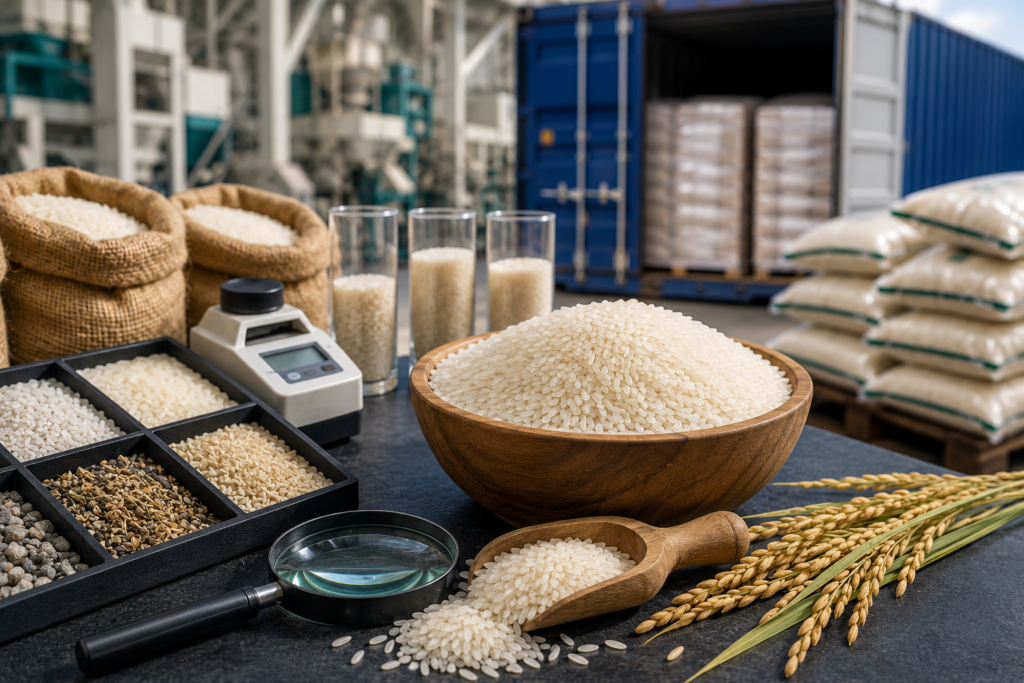
Why Rice Quality Matters
For importers, rice quality directly affects:
- customer satisfaction
- repeat purchases
- restaurant performance
- retail sales
- cooking consistency
- brand reputation
A poor-quality shipment can lead to:
- customer complaints
- product returns
- operational losses
- damaged business relationships
This is why quality evaluation should always be a priority.
- Grain Length and Uniformity
One of the first indicators of rice quality is grain size consistency.
Buyers generally evaluate:
- grain length
- grain width
- uniform appearance
Uniform grains improve:
- visual appeal
- cooking consistency
- customer perception
Premium rice varieties often command higher value because of their consistent grain structure.
- Broken Percentage
Broken grains are one of the most important rice quality parameters.
During milling and handling, some grains may break.
Rice is often classified by:
- 5% broken
- 10% broken
- 25% broken
- higher broken percentages
Lower broken percentages are generally preferred for:
- premium retail
- hospitality
- export markets
Higher broken percentages may be suitable for specific industrial or bulk-use applications.
- Moisture Content
Moisture plays a major role in storage and transportation.
Excess moisture may increase the risk of:
- spoilage
- mold growth
- reduced shelf life
Most importers prefer moisture levels within internationally accepted standards to ensure product stability during shipping and storage.
- Purity and Foreign Matter
A high-quality rice shipment should be free from:
- stones
- husk particles
- dust
- foreign seeds
- unwanted materials
Purity levels influence:
- food safety
- processing efficiency
- consumer confidence
Modern rice manufacturers typically use advanced sorting and cleaning systems to achieve higher purity standards.
- Color and Appearance
Visual appearance often determines first impressions.
Importers typically evaluate:
- grain color
- brightness
- uniformity
- overall presentation
A clean, consistent appearance helps improve acceptance in retail and hospitality markets.
- Cooking Performance
Ultimately, customers judge rice after it is cooked.
Important factors include:
- texture
- aroma
- softness
- water absorption
- grain separation
Consistent cooking performance is especially important for:
- restaurants
- hotels
- catering businesses
- Packaging Standards
Packaging plays a major role in export success.
Strong packaging helps protect rice from:
- moisture
- contamination
- transportation damage
Importers often evaluate:
- packaging durability
- labeling quality
- retail presentation
- bulk packaging options
- Export Compliance and Documentation
A professional rice exporter should provide:
- export documentation
- quality certifications
- shipment records
- traceability information
Proper documentation helps avoid delays and improves customs clearance efficiency.
Common Mistakes Importers Make
Many buyers focus heavily on price while overlooking quality indicators.
Common mistakes include:
Choosing the Lowest Price
Lower costs may result in inconsistent quality.
Ignoring Broken Percentage
This directly impacts customer perception.
Not Reviewing Samples
Samples provide valuable insights before large orders.
Overlooking Packaging
Poor packaging can damage product quality during transit.
Failing to Verify Supplier Capacity
Suppliers should be capable of supporting future growth.
Why Long-Term Quality Matters
The most successful food businesses understand that quality consistency is more valuable than short-term savings.
Reliable rice quality helps:
- strengthen brand reputation
- improve customer retention
- reduce complaints
- support long-term business growth
This is why leading importers prioritize trusted rice suppliers rather than simply chasing the lowest available price.
The Future of Rice Sourcing
As global food markets become increasingly competitive, buyers are becoming more selective about sourcing partners.
Today’s importers expect:
- transparency
- consistency
- quality assurance
- reliable supply chains
- professional export support
Rice quality standards are no longer optional—they are a critical part of successful international trade.