
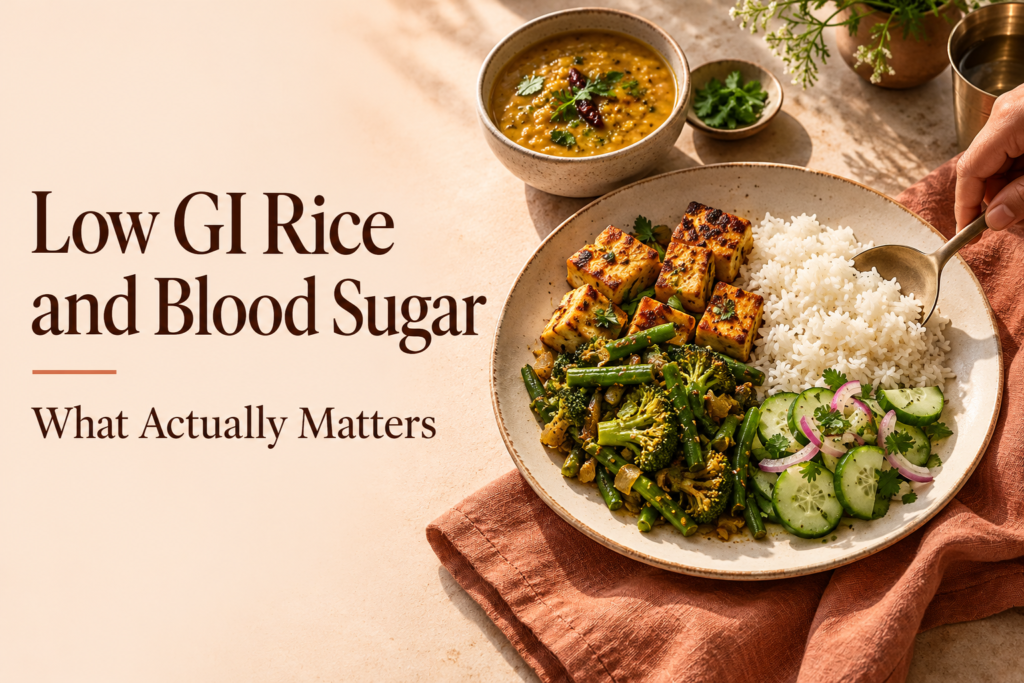
Low GI Rice and Blood Sugar: What Actually Matters
Rice is a staple in millions of Indian households, but worries about blood sugar make many people wonder whether they should give it up. The good news: you do not have to stop eating rice. What actually matters is the type of rice you choose, how much you eat, how you cook it and what you serve alongside it.
That is why more families are switching to low GI rice. Low GI rice releases glucose slowly, which helps stabilise blood sugar after meals, so you can keep enjoying dal-chawal, pulao and curd rice every day.
In this guide, we explain how low GI rice affects blood sugar, the difference between GI and glycemic load, the five things that really decide your blood sugar after a rice meal, and practical Indian meal combinations that work.
Note: This article is for general information. For personal medical advice, please consult your doctor.
Why Rice and Blood Sugar Matter in India
India’s blood sugar challenge: The ICMR-INDIAB study, published in The Lancet Diabetes & Endocrinology in 2023, estimated that 101 million Indians have diabetes (11.4%) and another 136 million have prediabetes (15.3%). With rice on most Indian plates every day, choosing the right rice is one of the simplest changes a family can make. Read more on low GI rice and prediabetes.
Rice is mostly carbohydrate. When you eat it, your body breaks that carbohydrate down into glucose, which enters your bloodstream. How fast that happens depends largely on the rice you choose, and that is exactly what the glycemic index measures.
What Is the Glycemic Index (GI)?
The glycemic index (GI) ranks carbohydrate foods by how quickly they raise blood glucose compared with a reference food:
| GI Range | Category | Blood Sugar Response |
|---|---|---|
| 55 or below | Low GI | Slower, more gradual rise |
| 56–69 | Medium GI | Moderate rise |
| 70 or above | High GI | Faster rise |
Rice is not one single GI food. Two rices can look alike on your plate and still give very different blood sugar responses. For the full picture, read our complete guide to the glycemic index of rice.
What Makes Rice High or Low GI?
Rice starch is made of two components: amylose, which is digested slowly, and amylopectin, which is broken down quickly. Research consistently shows that rice with a higher amylose content has a lower GI.
Milling and processing affect how quickly the starch becomes available, and cooking changes its structure too. That is why the best way to know a rice is truly low GI is a tested GI value. Low GI rice by Gatti Fit Grain has a tested GI of 51, well within the low GI range.
Low GI vs Glycemic Load: Why Both Matter
GI tells you how quickly a food raises blood sugar. Glycemic load (GL) adds the portion: GL = GI × grams of available carbohydrate ÷ 100. A GL of 10 or below is low, 11–19 is medium and 20 or above is high.
Here is what that means for two servings with the same 30 g of available carbohydrate (illustrative example):
| Rice | GI | Glycemic Load (30 g carbs) | GL Category |
|---|---|---|---|
| Regular white rice (average) | 73 | 21.9 | High |
| Low GI rice by Gatti Fit Grain | 51 | 15.3 | Medium |
Same portion, noticeably lower glycemic load. Choose low GI rice and keep portions sensible, and you get the best of both.
5 Things That Actually Affect Blood Sugar After Eating Rice
Choosing low GI rice is the biggest single step. These five factors together decide how your body handles a rice meal:
| Factor | Why It Matters | What to Do |
|---|---|---|
| 1. Rice variety | Different rices have different GI values | Choose a tested low GI rice such as Gatti Fit Grain (GI 51) |
| 2. Portion size | Even low GI rice contains carbohydrates | Keep rice to about a quarter of your plate |
| 3. What you eat with it | Protein, fibre and healthy fats slow digestion of the whole meal | Pair rice with dal, vegetables, paneer, eggs or fish |
| 4. Cooking method | Overcooked, mushy rice is digested faster | Cook rice until soft but separate |
| 5. Your individual response | Activity, insulin sensitivity and medication all play a role | If you monitor glucose, use your readings to fine-tune portions |
Bottom line: the right rice, the right portion and the right pairings work together to keep blood sugar steadier.
Does Low GI Rice Help People With Diabetes?
Yes. Low GI rice releases glucose more slowly, which helps stabilise blood sugar after meals. For people with diabetes, swapping regular white rice for low GI rice is one of the easiest everyday changes, especially when combined with sensible portions, plenty of vegetables, protein and regular activity.
Keep following your doctor’s advice on medication and diet. For more, read our guides on the best rice for diabetics and whether you can still eat rice with diabetes.
How Much Rice Should You Eat at a Meal?
The right amount depends on your activity level, health goals and blood sugar response. An easy guide that works for most people is the plate method recommended by the American Diabetes Association:
| Part of the Plate | What to Fill It With | Indian Examples |
|---|---|---|
| Half | Non-starchy vegetables | Bhindi, lauki, palak, beans, broccoli, cucumber salad |
| One quarter | Protein foods | Dal, paneer, eggs, fish, chicken, rajma, chana |
| One quarter | Carbohydrate foods | Low GI rice, roti, millets |
If you have diabetes or prediabetes, your doctor or dietitian can help you set the right portion for you.
What Should You Eat With Low GI Rice?
Build every rice meal around protein and fibre. These Indian combinations make balanced, satisfying plates:
| Rice Meal | What It Adds | Good For |
|---|---|---|
| Low GI rice + dal + mixed vegetables + curd | Protein, fibre and probiotics | Everyday lunch |
| Low GI rice + grilled paneer + vegetable sabzi + salad | Protein and fibre | Vegetarian dinners |
| Low GI rice + fish + leafy vegetables + cucumber salad | Lean protein and greens | Non-vegetarian meals |
| Low GI rice + rajma or chana + sabzi | Plant protein and fibre | Filling weekend meals |
Does Cooking Change Rice’s Blood Sugar Response?
Yes. Cooking time and how much water the rice absorbs change its starch structure. Very soft, mushy rice is digested faster than rice cooked until just tender with separate grains.
Never undercook rice to lower its GI. Cook it properly, and start with a low GI rice for the biggest difference.
Does Cooling Rice Matter?
Yes. When cooked rice cools, part of its starch turns into resistant starch, which is not digested in the small intestine. In a 2015 study in the Asia Pacific Journal of Clinical Nutrition, white rice that was cooked, refrigerated for 24 hours at 4°C and then reheated had about 2.5 times more resistant starch than freshly cooked rice, and gave a significantly lower blood sugar response.
How to Cool and Store Rice Safely
- Cool cooked rice quickly, ideally within 1 hour.
- Store it in the fridge and eat it within 24 hours.
- Reheat until steaming hot all the way through.
- Reheat rice only once.
Food safety guidance from the NHS and Food Standards Scotland.
Low GI Rice vs Regular White Rice
| Factor | Low GI Rice by Gatti Fit Grain | Regular White Rice |
|---|---|---|
| GI value | 51 (low) | About 73 (high) |
| Blood sugar rise | Slower and steadier | Faster |
| Glycemic load (same portion) | Lower | Higher |
| Best for | Everyday family meals | Smaller, occasional portions |
White rice GI is the average for boiled white rice from the International Tables of Glycemic Index (2008). Gatti Fit Grain’s GI of 51 is based on Gatti’s product testing. For a detailed comparison, read low GI rice vs white rice.
How to Choose the Best Low GI Rice
Look beyond labels like “diabetic-friendly” or “healthy rice”. The best low GI rice gives you:
| What to Look For | Why It Matters |
|---|---|
| A specific tested GI value | A number like “GI 51” tells you far more than a vague claim |
| GI of 55 or below | Confirms the rice is in the low GI range |
| Clear nutrition information | Shows the carbohydrate content per serving |
| Everyday cooking quality | Works in dal-chawal, pulao, khichdi and curd rice |
| A trusted brand | Reliable processing, quality and packaging |
Why Choose Gatti Fit Grain Low GI Rice?
- Tested GI of 51, well within the low GI range
- Helps stabilise blood sugar after meals
- Made for everyday Indian cooking, with no change to your recipes
- One rice for the whole family: from healthy rice for kids to parents managing insulin resistance or PCOS
- Easy to buy: available on Amazon in 2 kg, 5 kg and 10 kg packs
Curious what changes when you make the switch? Read what happens to your body when you switch to low GI rice, or see how it fits rice for weight loss.
Common Myths About Low GI Rice
| Myth | Fact |
|---|---|
| Low GI rice does not raise blood sugar at all | It raises blood sugar more slowly and steadily than high GI rice |
| You can eat unlimited low GI rice | Portion still matters, because rice contains carbohydrates |
| All white rice has the same GI | GI varies with the rice, its starch, processing and cooking |
| People with diabetes must give up rice | Low GI rice in sensible portions helps stabilise blood sugar after meals |
| Only the rice matters | The whole plate, with vegetables, protein and fibre, shapes the response |
Conclusion
When it comes to rice and blood sugar, what actually matters is simple: choose a low GI rice, keep portions sensible, pair it with dal, vegetables and protein, and cook it well.
With a tested GI of 51, low GI rice by Gatti Fit Grain helps stabilise blood sugar after meals and fits every everyday Indian rice dish. Buy low GI rice online on Amazon and make the smarter switch for your family today.
Frequently Asked Questions
Does low GI rice raise blood sugar?
Yes, but more slowly and steadily than high GI rice. Low GI rice releases glucose gradually, which helps stabilise blood sugar after meals.
Which rice is best for blood sugar control?
A tested low GI rice is the best everyday choice. Low GI rice by Gatti Fit Grain has a tested GI of 51 and helps stabilise blood sugar after meals.
Is low GI rice good for diabetics?
Yes. Low GI rice releases glucose slowly, making it a smart everyday rice for people with diabetes when eaten in sensible portions with dal, vegetables and protein.
Does white rice spike blood sugar?
Boiled white rice has an average GI of about 73, which is high, so it raises blood sugar faster. Switching to low GI rice and pairing it with protein and vegetables gives a steadier response.
How much rice can a diabetic eat?
A good guide is about a quarter of your plate, with half the plate vegetables and a quarter protein. Your doctor or dietitian can set the right portion for you.
Does eating dal with rice lower the blood sugar response?
Pairing rice with dal, vegetables and other protein and fibre slows digestion of the whole meal, which helps keep the blood sugar rise gentler.
Is cooled rice better for blood sugar?
Cooling cooked rice increases resistant starch. In one study, rice refrigerated for 24 hours and then reheated gave a lower blood sugar response than fresh rice. Cool it within an hour and reheat only once.
If this guide helped you, we’d love to hear from you. Share your thoughts or questions with us at gattifoods@gmail.com, and we’ll be happy to connect with you.